Every year, thousands of Pakistani students search for the same thing: a clear, current guide to the Germany study visa from Pakistan. Germany keeps pulling students away from the UK, Canada, and Australia. The reason is simple. Public universities charge little to no tuition, yet the degree still carries full global recognition. So if you’re comparing options right now, the cost difference alone changes the whole decision.
This guide answers the exact questions Pakistani applicants type into Google: how much does Germany tuition cost, what is the Germany study visa language requirement, and how do you get Germany permanent residency after you graduate. We’ll also cover what changes for the 2027 intake. For official program listings and a free eligibility check, visit our Study in Germany from Pakistan page.
Table of Contents
- Why Study in Germany from Pakistan?
- Germany Study Visa Requirements for Pakistani Students
- Germany Tuition Fees 2026: How Much Do Universities Charge?
- Germany Cost of Living for International Students
- Germany Blocked Account 2026: How Much Do You Need?
- Germany Study Visa Eligibility Criteria: Who Can Apply?
- Germany Study Visa Language Requirement: Do You Need IELTS?
- Germany Student Visa Work Rights: How Many Hours Can You Work?
- Germany Job Seeker Visa After Graduation: How Long Can You Stay?
- Germany Permanent Residency After Study: How Long Does It Take?
- Germany Tuition Fees and Visa Update 2027: What’s Changing?
- Step-by-Step: How to Apply for a Germany Study Visa
- Common Mistakes Pakistani Applicants Make
- Frequently Asked Questions
Quick Answer
Most public universities in Germany charge zero tuition. So your main cost becomes living expenses, proven through a blocked account currently set near €11,904 per year. Pakistani applicants need a recognized academic qualification, English or German language proof, and admission from a German university before applying for the national D visa. Processing usually takes 6 to 12 weeks. After graduation, students get an 18-month job seeker visa, and many later qualify for permanent residency in as little as two years of skilled work.
Why Study in Germany from Pakistan?
Most students ask one simple question before choosing a country: what do you actually get for what you spend? On that measure, studying in Germany is hard to beat. Public universities run on a near-tuition-free model for both bachelor’s and master’s programs. As a result, your budget goes toward rent and daily life, not a five-figure tuition bill.
A German student visa also unlocks something most destinations can’t offer: visa-free travel across the 29-country Schengen area. Meanwhile, Germany’s economy faces a well-documented shortage of skilled engineers, IT professionals, and healthcare workers. That’s exactly why the government keeps expanding pathways for graduates to stay and work after their studies.
Germany Study Visa Requirements for Pakistani Students
Pakistani nationals need a national visa (Category D) for any program longer than 90 days. This differs from a short-stay Schengen visa, and applying for the wrong type is a common reason for delays. You’ll apply through the German Consular Services Portal, which now handles most of the process online instead of through in-person queues.
Before booking a visa appointment, you need an official admission letter from a recognized German university. Without it, the German mission in Pakistan won’t process your student visa application at all. Therefore, admission always comes before visa paperwork, never the other way around.
Germany Tuition Fees 2026: How Much Do Universities Charge?
If you’ve searched “how much are Germany tuition fees for international students,” here’s the direct answer. Public universities across nearly all 16 federal states charge zero tuition for bachelor’s, master’s, and PhD programs. Instead, you pay a small semester contribution that covers admin costs and often a transport pass.
| University Type | Typical Tuition Fee (2026) |
|---|---|
| Public universities (most states) | Free – semester fee only |
| Semester contribution fee | €150 – €400 per semester |
| Baden-Württemberg (non-EU exception) | €1,500 per semester |
| Select TUM programs (non-EU) | €2,000 – €6,000 per semester |
| Private universities | €5,000 – €20,000+ per year |
However, one exception matters. Baden-Württemberg, home to Stuttgart, Heidelberg, and Freiburg, charges non-EU students around €1,500 per semester. A few programs at the Technical University of Munich also charge non-EU students separately. So always check your offer letter before assuming your specific program is tuition-free.
Germany Cost of Living for International Students
Tuition might be free, but daily life still costs money. Students searching “Germany cost of living for international students” usually want one number, and here it is: most students spend between €900 and €1,200 per month, depending on the city.
| Expense | Monthly Estimate |
|---|---|
| Accommodation (shared flat or dorm) | €300 – €700 |
| Food and groceries | €150 – €250 |
| Health insurance | €120 – €160 |
| Transport (often included in semester fee) | €0 – €80 |
| Personal expenses | €150 – €250 |
Munich and Frankfurt sit on the higher end, while smaller university towns cost noticeably less. Consequently, your city choice affects your monthly budget just as much as your lifestyle does.
Germany Blocked Account 2026: How Much Do You Need?
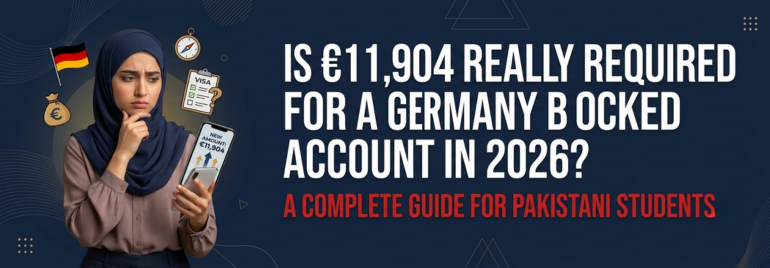
The blocked account (Sperrkonto) is the most important financial document in your visa file. It proves you can support yourself for a year without working, and the German government sets the amount based on its own living-cost calculations. For the 2026 intake, that figure sits at €11,904 per year, or €992 per month, deposited through an approved provider before your visa appointment.
This number isn’t fixed forever. So don’t rely on an old blog post for the exact amount when you actually apply. We keep our detailed blocked account guide updated with the current figure, since getting this wrong is one of the fastest ways to delay a visa appointment.
Germany Study Visa Eligibility Criteria: Who Can Apply?
Universities and the German consulate both check your file against the same four pillars. Meet all four, and your application has a genuinely strong foundation.
| Requirement | What It Means |
|---|---|
| Academic qualification | Bachelor’s degree for master’s programs; recognized high school diploma for bachelor’s programs |
| Recognized academic record | Transcripts must meet German equivalency standards; some fields require an APS certificate |
| Language proficiency | IELTS for English-taught programs, or a German certificate for German-taught ones |
| Financial proof | A funded blocked account covering one year of living expenses |
If your transcripts come from a board Germany doesn’t automatically recognize, you may need an APS certificate before applying. This step alone can take several weeks. Therefore, start it early, especially if you’re targeting a competitive field like engineering or business.
Germany Study Visa Language Requirement: Do You Need IELTS?
Not always, and this surprises many applicants who search “Germany study visa language requirement” expecting one fixed answer. Because Germany runs both English-taught and German-taught programs side by side, your language requirement depends entirely on which track you pick.
- English-taught programs generally ask for IELTS around 6.0–6.5, or an equivalent English test.
- German-taught programs require a German certificate, typically Goethe-Institut or TestDaF, usually at B1 or B2 level.
- Some universities accept a Medium of Instruction (MOI) letter instead of IELTS, if your previous education was entirely in English.
If skipping IELTS is your goal, an MOI letter is usually the fastest route. However, not every program accepts it, so confirm this directly with the university before you commit to an application.
Germany Student Visa Work Rights: How Many Hours Can You Work?
Students often search “how many hours can international students work in Germany,” and the rule is a little different from a simple weekly number. Germany allows 120 full working days or 240 half-days per year, which averages out to roughly 20 hours a week during term time.
This work permission applies from the start of your enrollment, so there’s no waiting period. Many students use this time to build local work experience, which later strengthens their case for the post-study job seeker visa.
Germany Job Seeker Visa After Graduation: How Long Can You Stay?
This is where Germany separates itself from most competing destinations. After finishing your degree, you become eligible for an 18-month job seeker visa, giving you a full year and a half to find employment before needing to leave the country.
During this window, you can take any job to support yourself while you search, not only roles tied to your degree. Once you land a qualifying job offer, you switch to a work visa. From there, the door to permanent residency opens much faster than most people expect.
Germany Permanent Residency After Study: How Long Does It Take?
This is one of the most searched questions among Pakistani graduates: “how to get PR in Germany after studying.” The honest answer is that graduation alone doesn’t grant permanent residency. Instead, it unlocks the fastest route to it that Germany offers.
The standard path to a settlement permit (Niederlassungserlaubnis) requires five years of residence. However, international graduates of German universities qualify for an accelerated track. After just two years of qualifying skilled employment, along with 24 months of pension contributions, B1 German, and basic integration knowledge, most graduates can apply for permanent residency.
| Route | Time to Permanent Residency |
|---|---|
| Standard route (non-graduates) | 5 years of residence |
| Graduate route (after German degree) | 2 years of qualifying skilled work |
| EU Blue Card route | Often the fastest, sometimes under 2 years |
In short, your time as a student doesn’t count toward this clock. What counts is what happens after graduation, once you move into qualified employment and start contributing to the pension system.
Germany Tuition Fees and Visa Update 2027: What’s Changing?
If you’re planning for the 2027 intake, a few changes deserve your attention. Germany hasn’t tightened its rules as aggressively as the US, UK, Canada, or Australia through 2026. Still, the process keeps evolving in specific ways.
| Change | What It Means for Applicants |
|---|---|
| Blocked account amount may rise | A proposed increase (around €28/month from winter 2027/28) is linked to Germany’s student-support rate changes; nothing is officially confirmed yet |
| APS/dMAT expansion | From Summer 2027, select Master’s applicants in Engineering, Commerce, Accounting, Finance, Economics, Business, and Management may need a dMAT certificate as part of APS |
| Fully digital application process | The Consular Services Portal continues replacing manual steps, which should cut wait times for complete applications |
None of these changes make Germany a harder destination overall. That said, they do reward applicants who start early and confirm requirements close to their actual intake date, rather than trusting a single blog post written months in advance.
Step-by-Step: How to Apply for a Germany Study Visa
- Secure university admission first. Your visa application can’t move forward without an official admission letter.
- Get your transcripts evaluated (APS, if required). Start early, since this can take several weeks.
- Take your language test. IELTS for English-taught programs, or the equivalent German certificate.
- Open and fund your blocked account. Complete this before your visa appointment.
- Arrange health insurance. This is mandatory, not optional.
- Book your visa appointment and submit documents. Processing typically takes 6–12 weeks, so apply early.
- Travel and register your address. Once in Germany, register locally and collect your residence permit.
Common Mistakes Pakistani Applicants Make
- Applying for the visa before admission is confirmed. The admission letter is a hard prerequisite, not a formality.
- Underestimating APS processing time. This step alone can take weeks and often gets left too late.
- Picking a program without checking the language of instruction. Some “English-friendly” universities still teach core modules in German.
- Funding the blocked account late. Visa appointments get delayed when this isn’t sorted in advance.
- Assuming every public university is fully tuition-free. Baden-Württemberg and a few specific programs are exceptions.
Frequently Asked Questions
Is studying in Germany really free for Pakistani students?
Most public universities charge zero tuition, though a small semester contribution still applies. You’re still responsible for living costs, health insurance, and the blocked account requirement.
How much are Germany tuition fees for international students in 2026?
Public universities charge no tuition in most states. Baden-Württemberg is the main exception, charging around €1,500 per semester for non-EU students.
How much is the Germany blocked account in 2026?
The current requirement is €11,904 per year, or €992 per month, though this figure is reviewed periodically and may change for future intakes.
What is the Germany study visa language requirement?
It depends on your program. English-taught programs usually require IELTS 6.0–6.5, while German-taught programs require a German certificate such as Goethe or TestDaF.
Can I study in Germany from Pakistan without IELTS?
Yes, if your program accepts a Medium of Instruction (MOI) letter, or if you’re applying to a German-taught program with a recognized German certificate instead.
How long does the Germany student visa process take?
Processing typically takes 6 to 12 weeks from submission, so apply several months ahead of your intended intake.
How many hours can international students work in Germany?
Students can work 120 full days or 240 half-days per year, which averages to roughly 20 hours a week during term time.
What happens after graduation — can I stay and work?
Yes. Graduates receive an 18-month job seeker visa, giving them time to find qualifying employment before transitioning to a work visa.
How long does it take to get PR in Germany after a master’s degree?
Graduates can qualify for permanent residency after roughly two years of skilled employment, compared to the standard five-year route for other applicants.
What’s changing for the Germany study visa and tuition fees in 2027?
Expect a possible rise in the blocked account amount, an expanded APS/dMAT requirement for select Master’s fields, and a continued shift toward fully digital applications.
Is an APS certificate mandatory for all Pakistani students?
Not always, but many universities require it for degree verification. Confirm with your specific university before assuming it’s optional.
What is Schengen access, and why does it matter for students?
A German student visa grants access to the 29-country Schengen area, allowing visa-free travel across most of mainland Europe during your studies.
Ready to Start Your Germany Study Visa Application?
Getting into a German university is only half the journey. The visa paperwork, the blocked account, the APS certificate, and the language requirements all need to line up correctly, and small mistakes here cost real time. This is exactly why working with a consultant who understands the process matters. Apex Visas has guided thousands of Pakistani students through Germany’s admission and visa process from start to finish, with honest, transparent advice at every step, not just a generic checklist. Their team stays updated on every policy change, including the shifts expected for 2027, so your application is never built on outdated information. If you’re serious about studying in Germany, visit our Study in Germany from Pakistan page or book a free consultation with Apex Visas today.